Build Story · Condition simulator · EN / BG
Sensorium: an ordinary day, from the inside
Live browser simulations of sight loss, hearing loss, tremor, aphasia and dementia, each dial set on a real clinical scale.
In one look
The problem
Most people losing their sight, hearing or words lose it slowly, and the people around them rarely know what is happening. A leaflet explains a condition. A blindfold shows total loss, which is rare.
What we built
Pick a condition, turn a dial that moves along a real clinical scale, then do an everyday task: read a label, catch a train, finish your dinner. Then see how to help. Nothing to install, no sign-up.
Where it is now
Live and free in English and Bulgarian: five sections (Seen, Heard, Held, Said, Thought), five whole-day pages, a 5-minute tour and a workshop mode for groups. It is for understanding, not diagnosis, and no section has had clinical review yet.
What this would have cost in 2024
About $29k and 6–10 weeks
2024 team: 3 people: WebGL/frontend developer, audio developer, content designer with clinical research and QA. Built here by one founder working with AI in 3 days.
| Piece | 2024 hours |
|---|---|
| Vision engine: 14 WebGL patterns, own-photo mode, neglect task, cataract dial | ~125 |
| Hearing engine: calibrated audio model, 6 conditions, hearing aid, audiogram, word test, 3 scenes | ~177 |
| Movement: tremor simulator with 6 tasks, one-handed stroke page | ~73 |
| Language and memory: aphasia, dyslexia, dysarthria, dementia | ~73 |
| Five whole-day pages | ~93 |
| Clinical scale research, condition design, How to help copy | ~73 |
| Home, 5-minute tour, workshop mode, result card, privacy-first counting | ~53 |
| Bulgarian layer across every section, synthetic voice clips | ~42 |
| Dark identity, hero and share image, QA rounds and contrast audit | ~52 |
| Total (PERT) | ~762 |
Method: PERT (O+4M+P)/6 per piece; low = O × $25, likely = PERT × $37.5, high = P × $50 (Accelerance 2024 Eastern-Europe band). These are estimates of what a team would have needed in 2024, not invoices.
How it was built
From first commit to current build in 3 days
- A prototype becomes one site
A browser prototype was ported to a React app. The vision, hearing and tremor simulators became sections of one site, Seen gained migraine aura and half-field loss, and Said Differently arrived for aphasia, with a Bulgarian switch.
86 commits that day - Made for groups
The same evening: How to help boxes, A day at 75 as a guided pharmacy visit, a 5-minute tour, a result card, a workshop mode that runs a group step by step, and visit counting that keeps nothing personal.
- Heard goes deeper
A hearing-aid option that shows what an aid fixes and what it doesn't, plus hyperacusis, Ménière's disease and single-sided deafness. Painful sound starts behind a warning card, and the vertigo sway is opt-in.
2 QA rounds with parallel agents · 10 fixes before it went live - A Parkinson's morning and a fifth section
A morning with Parkinson's: sign a form, get through a doorway with a metronome cue and pay by card, before and after the morning dose. Thought Differently adds memory: a dementia dial sets how fast what you just did fades.
- After a stroke, and after dark
One-handed after a stroke (open a pill bottle, cut dinner, send a text), visual neglect as a task page, and night blindness as the 14th vision pattern, with a sped-up clock for eyes adjusting to the dark.
shared shader checked live across all 14 patterns - A day after a stroke, and the rest of the list
A stroke day with a switch for which side of the brain was hit, a cataract grade dial, dyslexia, dysarthria, a day with diabetes and a sensory overload day that asks for consent before it starts.
each page smoke-tested in English and Bulgarian - A cinematic home and one dark look
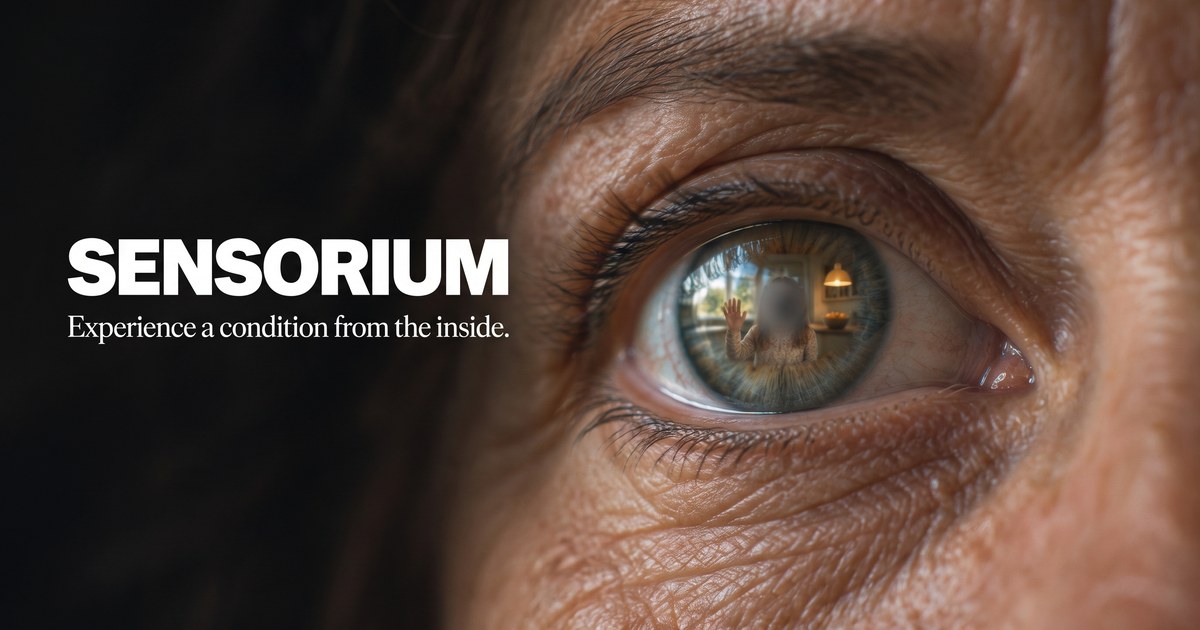
A macro photo of an eye with a blind spot became the hero and share image. The home page was rebuilt around it, and the whole site moved to one dark identity.
contrast audit · 3 fixes · clean re-audit
Who did what
The founder decided
- Each simulation follows a published clinical scale and says plainly what a screen can't show.
- English and Bulgarian ship together in the same change.
- Painful-sound and vertigo layers are opt-in, and nothing plays louder than typical hearing.
- Nothing personal is collected: only anonymous visit and task counts.
- No section is sold to an organisation before a clinician signs it off.
AI built and checked
- The site, built in Lovable from the founder's briefs, one approved design card per condition.
- Claude drafted each condition against a published clinical scale, with sources, for the founder to approve.
- Claude Code ran QA rounds with parallel agents that measured the audio chain, then traced the last bugs.
- Synthetic voices for the scenes and the Bulgarian word test, and an AI-generated hero image.
Stack
Want something like this for your team?
From one call to something live. The same method is in the Claude Operator Pack.
From the founder
You might also like
Shares React · TanStack Start

Shares React · TanStack Start

Shares TanStack Start · React